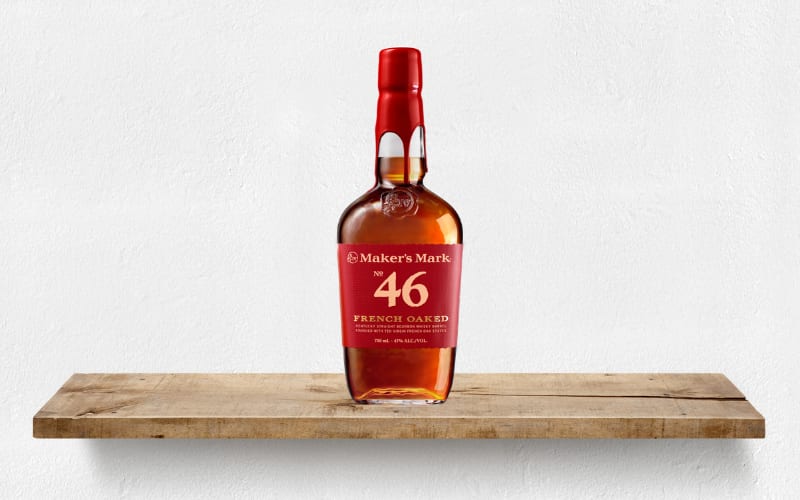
The World Whiskies Awards America 2026 has spoken, and finished bourbon is no longer a side conversation. Two expressions have claimed the title of World's Best Finished Bourbon this year, split between Kentucky and Non-Kentucky categories, and together they make a compelling case that the art of finishing whiskey has grown up.

Image credit: Maker's Mark
For years, finishing bourbon sat on the fringe. It was the kind of thing whiskey geeks talked about at the back of a bar while everyone else ordered the standard stuff. A handful of distilleries were experimenting with secondary barrel aging, but it never felt like a real category. It felt more like a curiosity. That has changed in a significant way. What started as a few barrel trials has turned into one of the more competitive corners of American whiskey, with producers using French oak, wine barrels, rum casks, and now Cognac barrels to push the profile of bourbon into new territory.
The two bourbons that came out on top in 2026 could not be more different from one another, and that contrast is exactly what makes this year's results worth paying attention to.
The Kentucky winner is Maker's Mark 46, a bottle that retails around $38 and has been on shelves long enough that some drinkers may have stopped thinking of it as anything special. That would be a mistake. Maker's Mark 46 was one of the early expressions to put finishing on the map in Kentucky, and its method is unlike most of what followed. Instead of pulling the whiskey out of its original barrel and dropping it into a second one, the distillery takes a different approach. Ten seared French oak staves get inserted directly into a fully matured barrel of standard Maker's Mark, and then the whole thing goes back down into a limestone cellar for additional time.
The base spirit is built on Maker's wheated mash bill, which gives the whiskey its well-known softness and rounded texture. That character does not disappear with the staves added. Instead, the French oak layers in spice, a deeper caramelized note, and a bit more structure while keeping the core of the bourbon intact. On the palate, drinkers find French oak upfront alongside caramel, baking spice, and vanilla, finishing with the kind of velvety quality that makes it easy to pour another glass. It is not showy. It does not try to be something it is not. It just works, and that consistency over the years is probably part of why the judges keep coming back to it.
The Non-Kentucky winner tells a different story. Redemption Cognac Cask Finish, priced around $66 and produced in limited quantities as part of the brand's Specialty Series, takes the more familiar two-barrel route. The base bourbon starts with a mash bill of 60% corn, 36% rye, and 4% malted barley, aged first in new charred American oak. After that initial maturation, the whiskey moves into Cognac barrels sourced from Ferrand, one of the more respected names in French brandy production.
The result is a bourbon that opens up in directions most American whiskeys do not go. The tasting notes read like something out of a fine dining menu — hibiscus, stone fruit, baking spices, clove, poached pear, buttered pecan, and praline. Bottled at 99 proof, it carries enough weight to hold all of those flavors without any one of them taking over. The high rye content in the mash bill provides a backbone that keeps the sweetness from the Cognac casks in check, so the whole thing stays balanced rather than veering into dessert territory.
Where Maker's Mark 46 works from the inside out, Redemption works from the outside in. The former is about controlling oak influence within a single barrel framework. The latter is about introducing European character into an American spirit without erasing what made it bourbon in the first place. Both strategies succeeded at the highest level, which says something meaningful about the range of directions the category has taken.
It is worth stepping back and recognizing how far this has all come. The early days of finished bourbon, represented by releases like Woodford Reserve Double Oak, were about proving that the concept could work at all. Those bottles had to justify their existence against a tradition that viewed any deviation from the standard aging process with suspicion. That era is over. Finished bourbon is not trying to prove anything anymore. It is competing on quality and winning.
The judges at the World Whiskies Awards do not hand out top honors to novelty. They are looking at what is actually in the glass, and in 2026 the glasses holding Maker's Mark 46 and Redemption Cognac Cask Finish were good enough to beat out every other finished bourbon in their respective categories worldwide. That is a significant achievement for both expressions, regardless of the very different roads they took to get there.
For anyone who has been watching bourbon develop over the last decade or two, this moment feels like confirmation of something that was always coming. The spirit has always had the bones to support this kind of experimentation. The producers who figured out how to finish well without losing the soul of the whiskey are the ones getting recognized now, and the two 2026 winners are as good an example of that as any.


